Showing posts with label japanese. Show all posts

1/18/2012

Making Homemade Gyoza

I think I've beaten to death on this blog how much Wifey and I love gyoza, the Japanese version of what Americans more commonly know as Chinese pot stickers and typically stuffed with a mixture of meat and vegetables. At just about every Japanese restaurant we go to it's a must-order for an appetizer.

Since we don't go out for Japanese all the time but do want to eat these more often, we decided to try our hands at making these at home. It's a decent chunk of time, but not really all that difficult. We also cheated just a little bit and bought the wrappers from our local Japanese food store (Uwajimaya for those of you in the Northwest), which saves quite a bit of the hard part.

First you have to make the filling. There are plenty of recipes out on the net, but the one we chose combines ground pork, shredded cabbage, ginger, garlic, pepper, salt, soy sauce, sake, sesame oil, and chopped nira. (There are tons of recipes out there to make all sorts of flavors, but the garlic and pepper to this one was our own interpretation.) You mix all of that together in a bowl and let it marinate, preferably overnight.


I'm sure most people have no idea what nira is, and that's because you won't find it in your grocery store (probably). If you can't, a substitution of scallions will work. So what is it? It's a relative of a chive and translates roughly as garlic chive. Here's what the bunch we bought looks like:


We took some of the leftovers and added it to some turkey stock we made and it adds a nice punch of extra flavor.

After the overnight marination, we laid out wrappers on a flat surface. Then we whisked up an egg and wiped the mixture around the edges of the wrappers, so it would stick together nicely when closed. Into the middle of each wrapper goes roughly a tablespoon of the meat mixture.


Then fold the wrapper over so it looks like a half moon, sealing and pinching the edges together. We added pinch-ridges (for the lack of a better term) in four or five spots around the sealed edge. These pinches, I believe, help hold the wrapper together when it heats in the frying pan.


After quite a bit of manual labor, you get a pan full of uncooked gyoza. We made two batches and in neither one did we get nearly as many as we were supposed to, so I guess we did more than a tablespoon. Whoops.


Now it's time for frying. We poured some sesame oil in the electric skillet, heated it, and then placed the gyoza in the pan to cook for two minutes. Then you add half a cup of water and cover them, cooking for another five minutes.


After the five minutes, remove the cover and let them cook until all the water is evaporated. At this point we flipped them over.


Most recipes don't call for turning the gyoza over and frying both sides, but we did it anyway for half of them because we like the crunch.


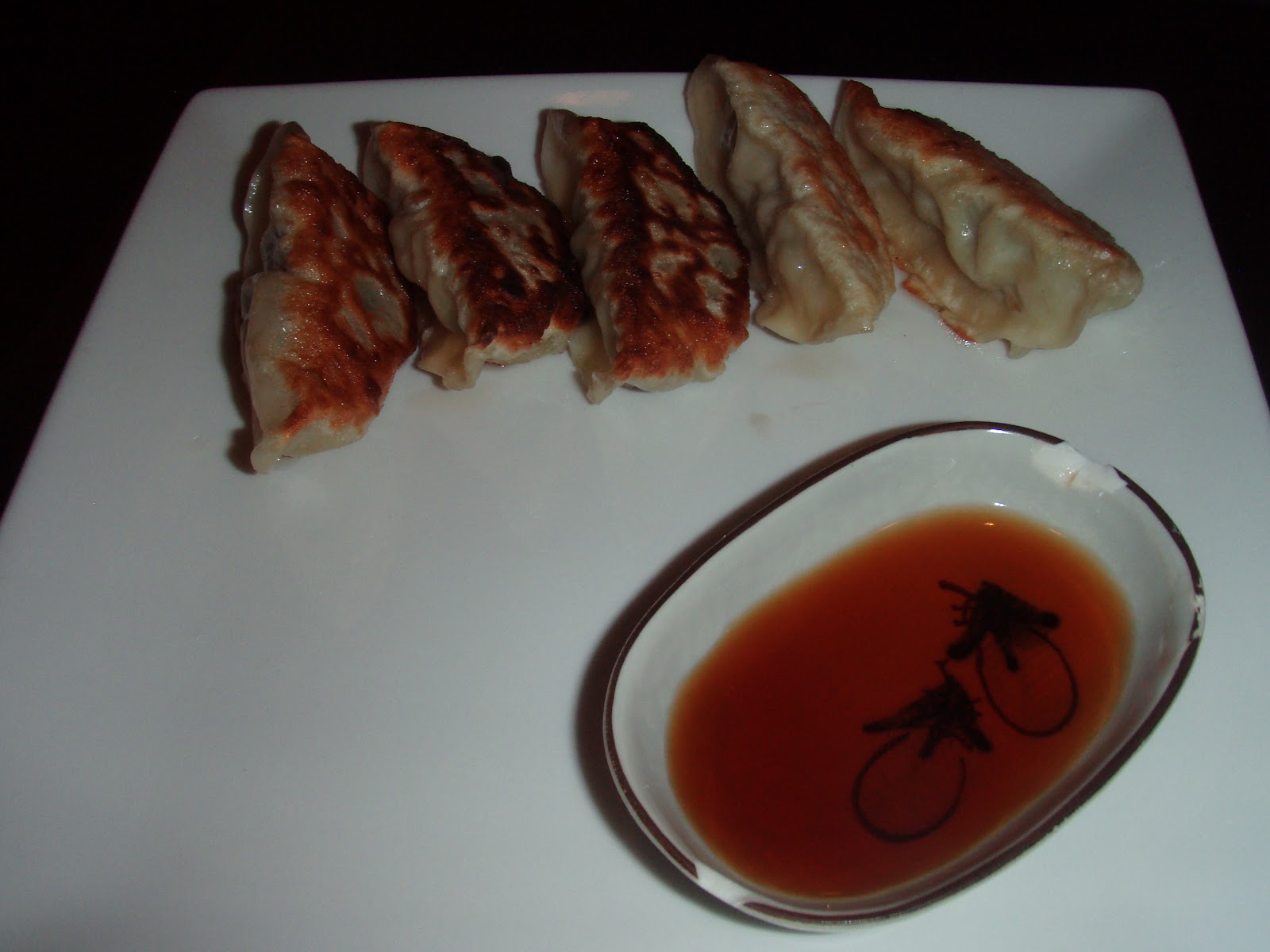
And then, when all is done, you have a plateful of tasty looking morsels!


The gyoza can be frozen either cooked or uncooked. We did it uncooked so we can have the nice, fresh crunch when we get them out.

I like eating them just as is after frying, but traditionally they are dipped in a sauce made up of soy sauce, rice vinegar, sesame oil and optionally crushed chile pepper or dry mustard if you want a kick.

Super tasty, fairly easy, a little time consuming...but you will absolutely impress your friends!

1/14/2012

Making Mochi at Home

Making mochi is not the easiest thing in the world. One would think that with just three ingredients it can't be that bad, but you would be wrong. It's one of the more labor intensive items - hard labor - to come out of our kitchen.

What is it? Mochi is a Japanese dish created from glutenous rice, usually sweetened but not always, pounded into shape, and can be filled with just about anything you desire. Traditionally mochi are made to celebrate the new year and are filled with an - a sweetened red bean paste.

On New Year's Eve Wifey's mom came over and supervised our creating of mochi because, well, we have no idea what we are doing. Here's the basic recipe we used:
1 box of Mochiko 
2 3/4 cups of water 
3 cups of sugar
The first item is this, mochiko - sweet rice flour, and can be found at any Japanese food store (we shop at Uwajimaya in Portland). The above is a little misleading because you need either more mochiko or cornstarch (or powdered sugar, we've read but not tried) for dusting the finished product, plus whatever you are going to use for filling.


You are also going to need some rather unique items, such as these:


These can also be found at a Japanese store and are the Japanese versions of a mortar and pestle. The bowl, called a suribachi, has many thin ridges on the inside in varying directions, which is key for the later steps of pounding the mochi. The stick is, well, for pounding.

You will also need a steamer of some sort and a cheesecloth.

First you mix the box of Mochiko and the sugar together. Add water and mix slowly, until you have a smooth mixture. You may not need all the water the recipe suggests, but knowing exactly how much is a fine line we haven't mastered yet. Wifey's mom was skeptical when we put it all in, saying it was too much, and she ended up being right. I have no idea how to determine what is too much.

After the steamer is ready, put the cheesecloth in it and pour the mochiko/sugar/water mixture in, making sure to keep it all inside the cloth. Cover the steamer and let it do it's magic for 20 minutes or so, until the mixture thickens and becomes more clear rather than milky. It should still be malleable and not completely hold it's shape.


Then you pour the mixture into the special bowl and the fun part begins. At the beginning this will be a little lumpy and the point of pounding the mixture is to smooth everything out. Pound away. Don't stop until the mixture loses any lumpiness and starts to take on an almost glue-like texture.


This may take awhile. Switch hands or switch people, as necessary. Did I mention this is not a one person job? Also, don't get this stuff on your clothes. It's not just "like" glue; I'm pretty sure it has alternative uses.


See this below? It's the an, a paste of red beans (azuki), sugar and salt. There are recipes for this, but it's also sold as a finished product at Japanese food stores. No matter what size you buy it will be way, way too much for a batch of mochi.


After the beating of the mochi, we poured the whole thing out on our marble pastry board we dusted with additional mochiko. For this batch, this was the point we realized there was too much moisture because it was super, super, super sticky. Here you should be able to rip off a chunk (it's still hot, just a warning) and form a nice ball, but ours was simply a sticky mess. We had to use way too much extra mochiko and then wait for it to cool a bit, which isn't ideal.


The general flow is you take a chunk of the mixture, roll it into a ball so the edges are smooth, make a dent in the middle and put in about a tablespoon of an, and then wrap it all up, sealing the edges. Then you get this:


See the one closest to the camera on the left? That was one I did. Don't make them look like that. Instead, they should look like the one to the right of that, which Wifey's mom did. That's the difference between an amateur and a pro.

Mochi food porn shot:


We were making these for the family New Year's celebration, so they got fancy cupcake wrappers.


Gratuitous finished mochi pic:


Super yummy. I'm not even a big fan of an, but once a year, in mochi, it's just the right thing to do.

Remember above how I mentioned all kind of things could be done to the mochi? Well, on the mochiko box is a recipe for Cocoa Mochi - no way were we going to let that go unmade. Plus, it's done in the microwave so it doesn't take very long at all.

Plus, we had some pretty damn good cocoa powder in the cupboard to use. Mmm, Valrhona...


Here is the chocolatey goodness that got whisked with the mochiko.


After microwaving everything together, we poured it into a Pyrex dish with parchment paper on top and bottom so we could easily get it out when it cooled for cutting.


It actually turned out very nicely. It had the normal soft consistency of mochi and a pleasant amount of chocolate flavor; noticeable, but not too much. Unfortunately that's the last picture I have because we were in a hurry when it came to cutting it and heading out to the family function. We kept some extra and set it aside, but notice the part in the recipe at the end where it says "store in airtight container and refrigerate"?

You should definitely do that. We didn't and we got some white spots on our leftover cocoa mochi, so we threw them out before taking another pic (sad face here). Trust me when I say it was really good, much easier to make than the other recipe, and you should try it.

Oh, and if you see this at the store, buy it:


Seriously, just do it. The Kona coffee one (you heard that right) is outstanding and I also really like the strawberry and vanilla. The ice cream inside the mochi is pretty dang good - good flavor, creamy - and one of these little guys is a nice little snack. At only 100 calories (I was surprised too) you won't have to spend too much extra time in the gym either.

So is homemade mochi worth it? I think it is. You can buy it in the stores, but it's honestly just not as good as fresh from your own kitchen. Even if it is a crapload of work.

11/17/2011

Dinner at Mirakutei

A couple months back I wrote about a fantastic lunch Wifey and I had at Mirakutei on East Burnside and I commented about how we needed to go back for dinner. So we did.

I won't rehash the history of the place. I'll just say we went for dinner on a Saturday night and did not have to wait at all - it was about half full. This, dear readers, is a travesty.

We started with some tempura - shrimp and broccoli.


Very lightly breaded and cooked just enough so not to be greasy but still be done thoroughly. 

And of course we had to get the gyoza, which were so damn good before. (We wanted the fried rice that we had before, too, but unfortunately it's not on the dinner menu.)


Again, cooked just right with a bit of crunch on the outside and the pork and onion mixture inside still soft. 

We also ordered a sushi roll, one called the crunchy roll, with shrimp tempura, crab, avocado, and a couple other ingredients. It was fantastic. 


Next up was kara-age, or fried chicken. Skinless pieces of chicken breast, lightly fried and a tad salty. Perfect.


Our last item was a special of the night, a slow cooked piece of pork belly. It melted in your mouth, both the meat and the fat layers. The sauce was a little sweet, too, which was a nice complementary flavor. I could eat this every night, though I may die of a heart attack or something.


Conclusion? Mirakutei is fantastic for lunch OR dinner! Seriously, go - it's right there at the top of best Japanese restaurants in Portland (as you can see, we've tried many). Kurata is good, but not quite this good, and Yuza, Wafu, Shigezo and Biwa are in a slightly different category as izakayas. We haven't yet been to Murata or Yakuza, but they are on the short list.

Oh, one more thing: this entire meal was $33. Not bad at all.

9/24/2011

Wafu Isn't Traditional, But We Don't Care

In a previous post I extolled the traditional cuisine at Mirakutei, but a visit to Wafu (like to Portlandfood.org because Wafu's website is just a shell) was a trip to the complete other end of the Japanese food spectrum.

That's not good or bad, it's just different. And you know what? Different can be pretty damn awesome.

I started off with a glass of Rogue's Morimoto Soba Ale. It's a very light beer, but has a nice developing crispness to it. Solid beer, but $8/glass is a bit much for me.

Our food started with a ceviche with mahi mahi, tomato, corn, calabrian chile, cilantro and mint.


This was fantastic. I'm not normally a mahi mahi fan, but these pieces were luscious and tasty - and that sauce I could drink a glass of. See the corn? Freeze-dried, I believe, which added an interesting layer. 

We also ordered an onigiri (rice ball) with grilled prawn, tomato, bacon, and soy mayo, topped with bonito (fish flakes) and nori (seaweed). Since it's rice on the outside and the restaurant was dark, the photo didn't turn out at all. This was a tasty bite, but didn't hold together well. Probably wouldn't get again.

This next dish was the star of the night: tempura shrimp with creamy spicy sauce and with wasabi mayo, plus a daikon palate cleanser.


And a closer look just at the tempura shrimps (wasabi mayo on the left, creamy spicy on the right):


We both liked the creamy spicy better, but it's really splitting hairs - both were fantastic. The daikon - something I don't normally eat raw - was nice between the two different flavors of shrimps, allowing the tongue to fully enjoy the flavors of each.

Our last dish of the night was the reason we went in the first place: Wafu ramen with pork belly and slow poach egg added. The ramen comes with corn, scallions, kamaboko (that's the pink-rimmed thing - a fish cake), and smoked schmaltz (rendered pork fat used for frying).


The pork was perfectly cooked and literally fell apart in the bowl. I liked the corn addition (highly recommended from Japan), but Wifey wasn't in love with it. The egg was nicely done. The broth, though - wow. Awesome. So many levels of porky goodness. I'm not sure it's better than Mirakutei, but it was damn, damn good.

But again, not traditional - none of this was traditional Japanese, but quite obviously Japanese inspired. It was good, very good, and we wouldn't hesitate to return.

Besides, it's right next door to Sunshine Tavern. And a block away from Pok Pok. And just up the street from Taste Unique and Little T American Baker. Maybe we should move closer.

9/13/2011

Mirakutei: Traditional Japanese Goodness

Last week Wifey and I got a hankering for some good Japanese ramen and tried out two different places. The first one was Mirakutei (the link is to Facebook, because their other page is devoid of info), a small shop on East Burnside, near Burnside Brewing and Le Pigeon. It's housed in a newer building and run by the same man (Hiroshi) who ran Hiroshi's, a sushi spot in Northwest. Both places were running for awhile, but Hiroshi's recently was closed and Hiroshi now does sushi (only for dinner) at Mirakutei. 


The lunch menu offers a choice of two different bentos, a few different ramens, and some small plates. We started off with some fried rice. 


This was, in short, perfectly traditional (as far as fried rice goes, which no, is not a Japanese dish) and perfectly tasty. And cooked perfectly. Great flavors, good size of veggies, and everything worked. Wifey says it might be the best she's ever had. 

Next up, the gyoza - we always have to get gyoza.


As you can see the gyoza had a nice crunch on the outside, but still were soft. The onion and pork ratio also was spot on. And that sauce? Normally I don't really care for gyoza sauce, but this one I could drink it was so good. No idea if it's housemade, but it's damn good.

Wifey ordered the tonkatsu and salmon bento, which also came with a side of rice, some tempura veggies and a tempura shrimp.


The pork tonkatsu also was cooked just right. Crunchy, but still moist and still recognizable as pork. We had a bad experience with a restaurant's tonkatsu a couple weeks back and this buried that memory. The tempura was nice, not overly battered and still preserving the flavors of each vegetable. The salmon...well, it was just okay. There was something in the flavor I wasn't a fan of, something that made me thing it wasn't the greatest quality fish. Hiroshi's was known for it's high quality fish, so I don't know what the deal was...or maybe I'm just spoiled from Copper River salmon fillets. Shrug.

The last dish we ordered was the Genki Ramen, which is a white miso base with scrambled egg, shredded pork, and topped with bean sprouts.


Absolutely fantastic. The broth was rich and full of flavor, garlic and pepper adding depth and a kick, the egg and pork adding just the right amount of goodness, and even the bean sprouts - which I don't normally eat - seemed to just fit with their added crunch. The noodles were also perfectly cooked.

And you know what else? We got there when it opened at 11:30 and despite ordering and eating our way through four dishes, only one other customer showed up. I'm not sure if it's the location isn't conducive to a lunchtime spot on the weekday or what, but we had the place to ourselves.

We both highly, highly recommend Mirakutei and we absolutely will return. Next time we may have to go for dinner to try out Hiroshi's legendary sushi to go with the ramen. And fried rice. And gyoza. Might have to skip lunch that day.

3/11/2011

In Honor of Japan

I probably should be working on my novel, but I can't think about a lot else with all the images and stories coming out of Japan after the horrible earthquake - and resulting tsunamis - off the coast of Sendai Thursday evening (US Pacific time). Normally the stories don't grab me too much, but Japan? Japan has a special place in my heart.

It didn't necessarily start out that way. I signed up to take Japanese my freshman year in high school because none of Spanish, French, or German excited me. I ended up taking it all four years and then another four in college, earning my B.A. in the language. Then I fell for a beautiful American Japanese girl, brought home a couple Japanese dogs, and finally took a trip there with my wife and her mother (who was born and raised in Japan before moving to the U.S. when she got married) a few years back. It was a pilgrimage of sorts for me, a culmination of something I spent many, many hours of my life studying.

In the wake of the horrible news in Japan, I went back and looked through our pictures and realized I never wrote about our trip. That was before I had a blog and these pics have never been published anywhere, so I decided why not now? They are of a happier time in Japan for sure and aren't necessarily meant to draw any specific emotion, but if it happens, it happens. They bring me happy memories. (And if you would like to donate to the Red Cross to help support the relief effort, I'll offer you a link to make it easier.)

GOBO

It's a safe bet you have never heard of the town of Gobo. This is where Wifey's uncle lives, about 45 minutes south of Osaka. It's on the west side of Honshu (the main island of the chain, also home to Osaka and Tokyo), but protected a bit from the open ocean. Her uncle's home is about two miles (very rough guess) from the shore, with only rice fields in between, which means it's very, very flat.

This first picture is from the Gobo coastline, looking south. That's a desalinization plant. Around that point is much less protected from what could be a tsunami coming south from Sendai. This region seems to have escaped the tsunami's wrath; there was a surge in this very spot, but only about one meter.


This second picture is an example of the rice fields that stand between the main part of Gobo and the coast. Houses are grouped together in stands of five or six, bordering fields. Her uncle is retired (not from farming), but (I assume) his neighbors handle these fields. As you can see it was not rice-growing season; we were there in late April and even then it was quite muggy.


OSAKA

We flew into Kansai Airport, a structure actually built on land placed out in the ocean, just off the coast of Osaka. Yes, I said placed - trucked out and built up, then stabilized to support the needs of a major international airport. Which, to us, sounds crazy, but it seems to work. If you go there try not to think about it too much.

Osaka is a crazy busy city, like a New York, but it's also a stop for one of the coolest things on the planet: Shinkansen, the bullet train. We rode the train from Osaka to Hiroshima and back (more on Hiroshima in a bit). It was super damn fast, but other than that not overly exciting.


We also had one of the most unexpectedly awesome meals of our lives in Osaka. A multi-course meal, at least 10 courses, maybe more - all rooted in crab. Here is a pic of the restaurant - if you have seen food travel shows in Japan, you may have seen this before:


The food was phenomenal. I don't even know what all we wait, but it was super damn good - and I'm not even a big fan of crab. The total bill for five I think was over $200. Not sure because I tried to grab the check and our hosts wouldn't let me. We also had Japanese curry from a place in Osaka - not a chance in hell I could find it again.

We also checked out Osaka-jo - Osaka Castle. Wifey and I made the trek up to the top, eight levels. The surrounding moat and grounds are just as impressive as the castle, and the views from the top are amazing.


KOYASAN

Koyasan is a cemetery on Mt. Koya (Mt. Koya is also referred to as Koyasan, just for reference). I hear it's one of the most picturesque and well-known cemeteries in Japan. The markers are all quite impressive and most are very, very well cared for. Here is an example of a family plot.


The grounds of the cemetery are just as impressive. Check out these trees. It was a nice place to wander around in for a bit.


KUDOYAMA

We went to Kudoyama with Wifey's cousin's family because their daughter was going to be in a traditional parade for, well, I honestly can't remember what the event was, but it's done every year. Here is a group of apprentice Buddhist monks, on the steps of the grounds leading into a temple.


This is at the top of those steps. To me, as an American, every time I saw something like this I had to stop and stare, but in Japan the amazingness of this architecture sometimes fades into the background because it's literally everywhere. Yes, I stopped and stared a lot. The vast majority of this pieces - gates, temples, etc. - are remarkably well maintained.


Wifey's cousin also took us to this fantastic traditional restaurant on the edge of town. She knew the owner and they opened just for our group for lunch, which was very nice of them considering they normally would have been closed for the festival. I can't remember what we ordered, but I had exactly zero bad meals in Japan. Everything was fantastic. Have I used that word enough?

Here are Wifey's cousin's daughters, Miho (pronounced like Me-ho) is on the right, and Rino (pronounced like Reno the city), the younger one, dressed in traditional garb. I'm not much for kids, but even I have to admit she's pretty dang cute.


NARA

The city of Nara was the capital of Japan before Tokyo, way back when, the home of many Emperors. We visited one day because Wifey's mom's cousin lived there, and she showed us some of the sacred grounds of Todai-ji. Inside this building is a giant statue of Buddha. I did take pictures of it, but none of them turned out.


This next picture is a simple city park, but oh so picturesque. The water had koi and cute little turtles in it.


In Nara we also had some real ramen. Yum. Need more ramen...

HIROSHIMA

When we planned this trip to Japan, I was asked what I wanted to see. Since "everything" wasn't an acceptable answer for a 10-day trip - and the choice was left to me since Wifey had been there before - I chose Hiroshima, namely the peace museum. Wifey's uncle then put together a trip for us with a travel agent, part of which was this beautiful traditional garden in the middle of the city. See those birds? Those are honest-to-goodness tsuru - or, as we say in English, cranes. These are the birds the origami good luck cranes are based on. Just kidding, those are fake. If you click on the picture you will see they have no knees and their legs go straight into the ground. Oh well, if there were real cranes here that would have been cool.


And here it is, Ground Zero. This is one of those places where when it comes into view you stop in your tracks, barely able to take in the entire site and the meaning behind it. It's a symbol of one of man's greatest evils and also a memorial so we never forget. Words don't do it justice.


This next picture is looking through the Memorial Cenotaph, over the Pond of Peace where the Peace Flame burns. Directly behind us is the Peace Museum itself, an emotionally draining experience that is at the same time engrossing and disturbing.


And while the crab meal was awesome, our favorite meal of the trip may have been in Hiroshima. And we didn't bring the camera. Wifey's uncle found a place where well over 20 different okonomiyaki stalls offered yummy food. Presumably they all had different specialties, I have no idea. The food was amazing, the preparation was entertaining, and I wanted to try them all. Too bad we were only there for one night. So now we make it at home fairly often.

MIYAJIMA

This side trip from Hiroshima to Miyajima was a fantastic bonus. Never heard of it? It's a small island housing a shrine on a small island just off the coast of Hiroshima called Itsukushima. This might generate some recognition:


This is a gate, called a torii. There are many, many beautiful pictures of this all over the net, but the day we were there it was overcast and the tide was on it's way out.

Here is another part of the shrine.


The contrast between the orange and white is breathtaking, and very painstakingly kept looking nice. This is a UNESCO World Heritage site, so I'm sure that plays a part.

I don't know the story being told by this performer below, but it probably has something to do with the sun deity, Amaterasu. There was also a wedding going on here when we visited, which we heard is quite common. Given the setting, I'm not surprised.


Another view of the torii, looking out to the water from the shrine. The wedding was in this room the picture is looking through.


OUR PUPS

As I mentioned, both of our dogs were/are Japanese. Ruby, our Akita we lost last year, was a half and half, meaning her mother was of traditional Japanese Akita blood while her father was American Akita. The American ones seem to be huskier, bigger. This is our Ruby during one of the few snowstorms we had during her lifetime here.


And of course, this is Misaki the Shiba. She is actually more Japanese than anyone else in this house, having actually been born a Japanese citizen in Kumamoto before being naturalized to the U.S. as a puppy. Thankfully for us she picked up English. I think. Not sure since she only responds occasionally.


SHIBAS IN JAPAN

So how about some more Japanese Shibas?! These are pictures of Shibas we took on our trip.

A white Shiba, hanging out at Osaka Castle while, presumably, their owners were inside.

This Shiba was with the white one - you can see their leashes somewhat match.

This Shiba was with an older man in Kudoyama at the festival. We got to pet her - see her cute pink rosebud? She was the most docile dog I have ever met - not like Misaki, who has to be in control.

And then there was the statue of Gon, a Shiba who was immortalized at the shrine in Kudoyama for his work leading pilgrims through the mountains to the Daimon Gate. At least, that's the story. Here is one hilarious version of it, told by a monk from the shrine.


Whether or not it's true, who knows? Like with all stories, it probably has some elements of truth and fiction. I swear when we were told the story the dog had not died just a few years ago. And if he had, could someone please tell me why he would be shepherding pilgrims in the 1990s? Does that make any sense at all?

***

Wifey and I had a great time in Japan and we can't wait to go back. The tragedy that has befallen the country is horrible, and like many of you we will be doing our part to help.